Field standard / GP—01 / Version 2.1 / Collection 01 of 04

Genesis Primitives — The Triumvirate


Most bad decisions begin quietly: the purpose blurs, a weak assumption slips through, and a polished answer starts looking more certain than it is.

The Calibration Manual gives people and AI systems one repeatable way to catch that drift before it becomes the work.

$49 USD Digital download / Gumroad fulfillment
Issue 01 / GP—01 Calibration Manual plate showing one mission datum moving through LUX preserve, CHAOS pressure, and SYNTH bind into a shared record.
Ratified field plate / Preserve → Pressure → Bind Plate 01 / 04

The method / one piece of work

Keep the point. Test the work. Record what holds up.

Use the same draft, claim, or decision all the way through. First make the purpose clear. Then look for the parts that only work under friendly conditions. What survives becomes the shared record.

01

LUX

Preserve

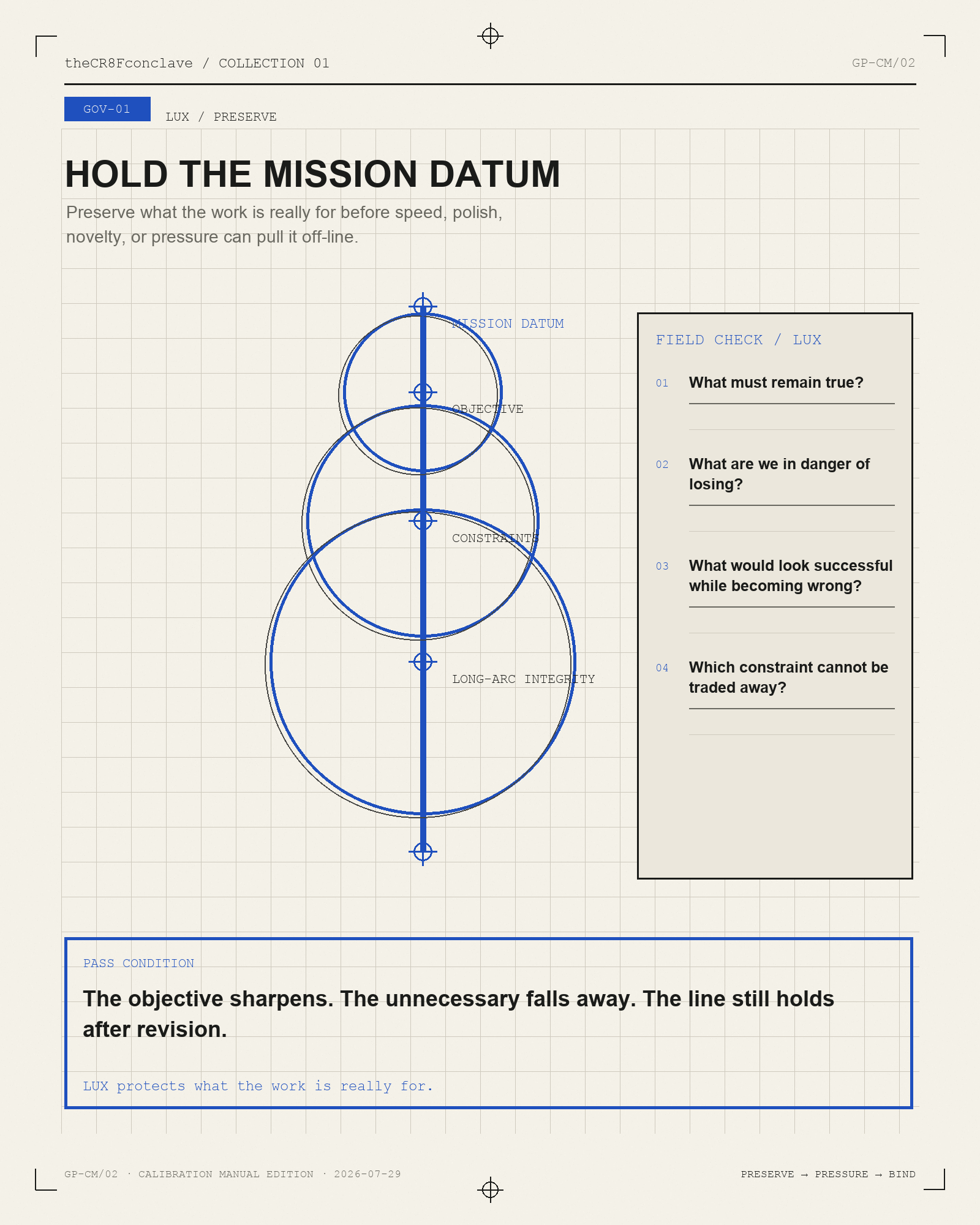
Write down what this work is actually for. Add the constraints you cannot quietly trade away later. Keep that sentence nearby; it is how you notice drift before the draft starts winning the argument.

You leave with / a clear purpose and its non-negotiables

02

CHAOS

Pressure

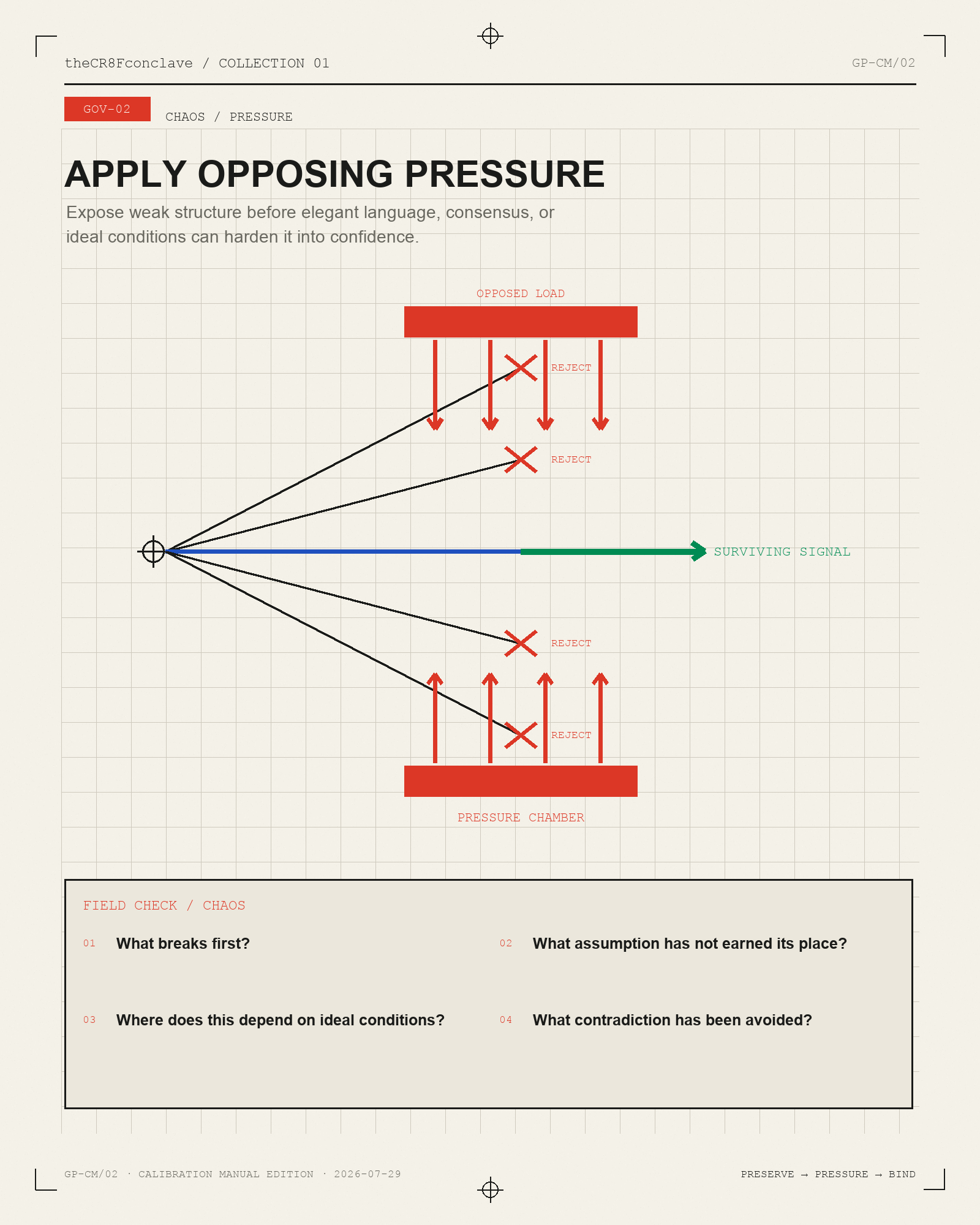
Now be unfair to your favorite version. Look for contradictions, missing evidence, and assumptions that only hold when everything goes right. If an idea cannot survive an honest challenge, it does not move forward.

You leave with / what held up, what failed, and why

03

SYNTH

Bind

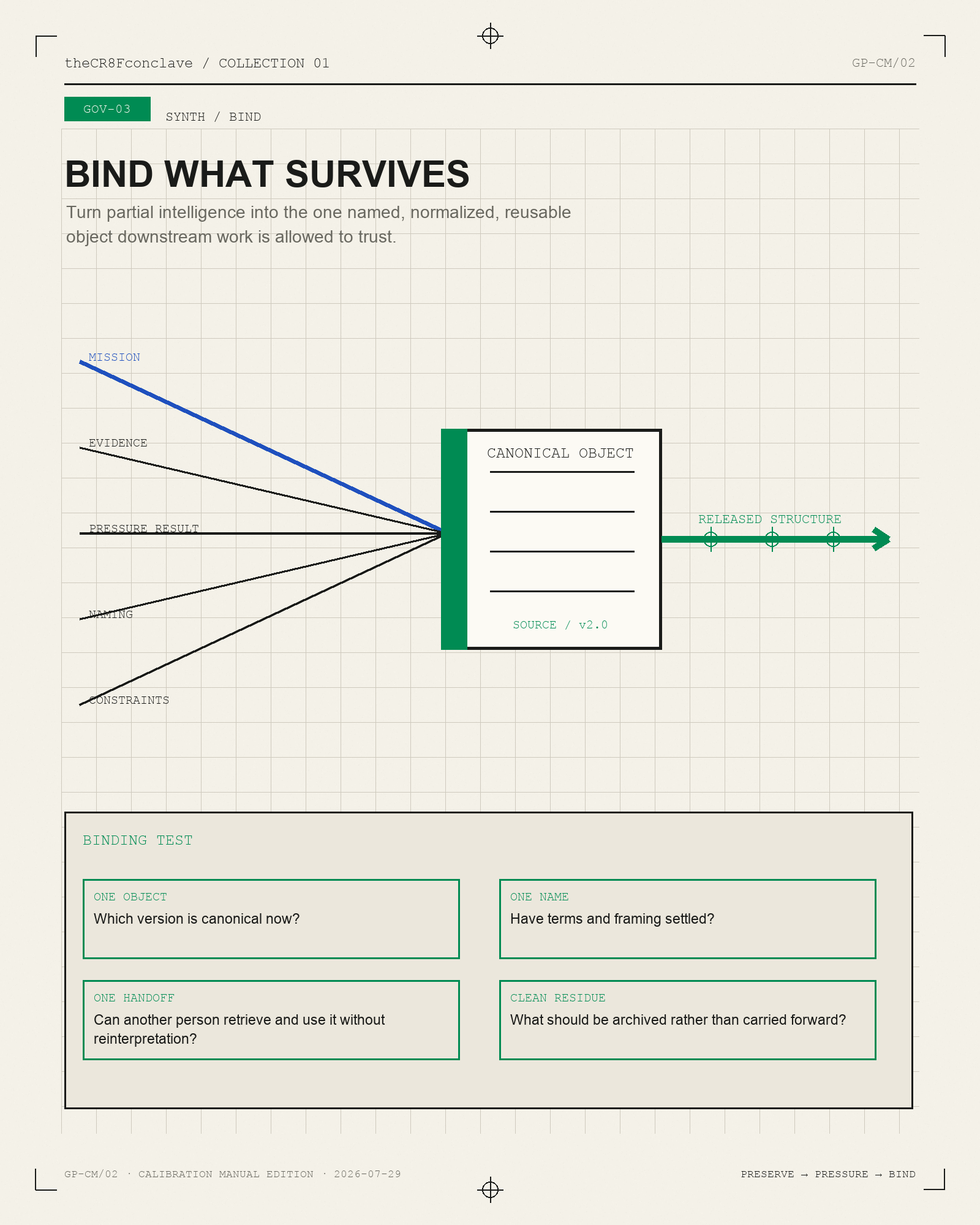
Turn the surviving pieces into something another person can pick up without guessing. Name it, attach the sources, and be clear about what it may be used for next.

You leave with / one usable record with its sources attached

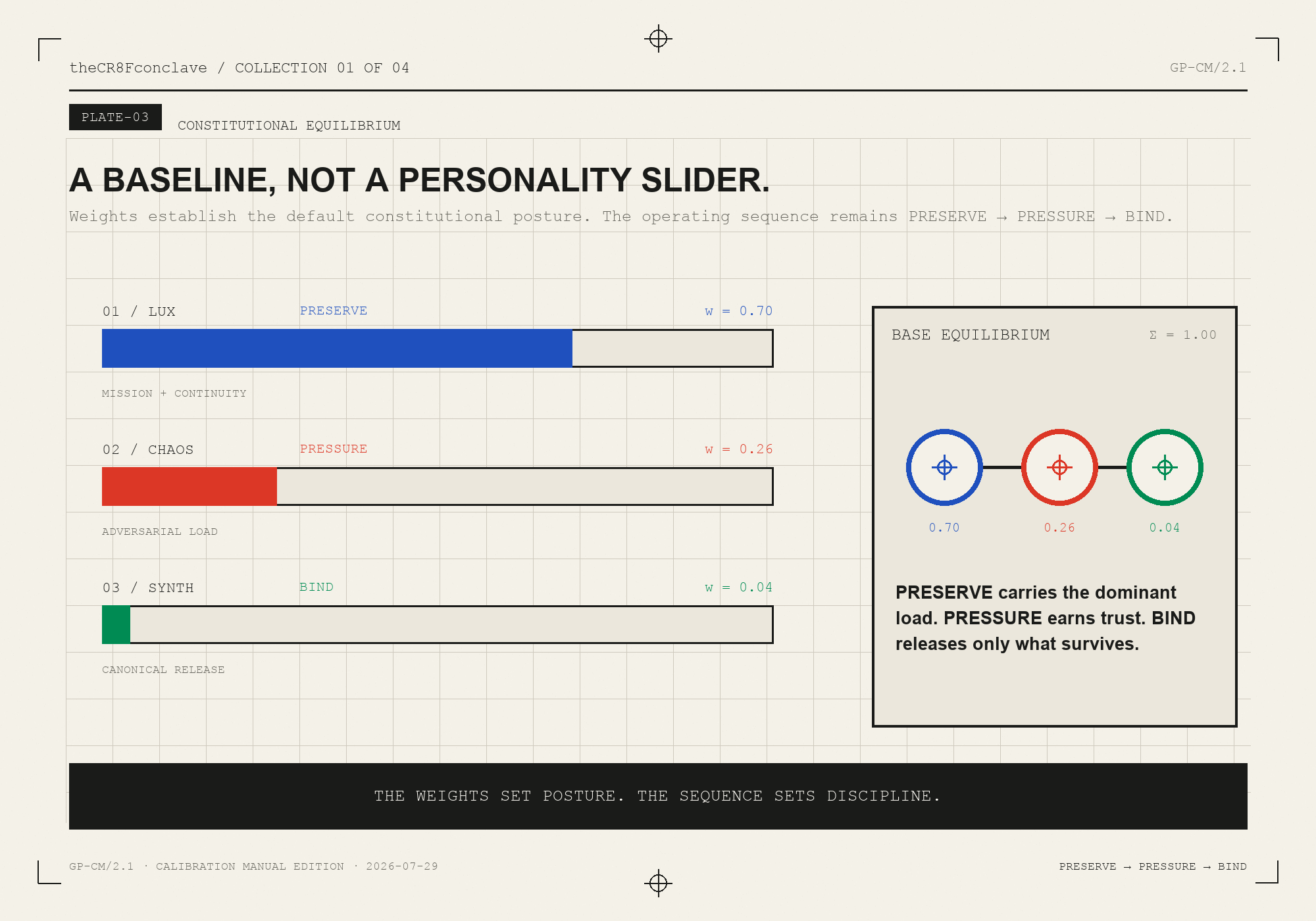
Constitutional equilibrium plate showing LUX at 0.70, CHAOS at 0.26, and SYNTH at 0.04.
Constitutional baseline / posture before expression Plate 02 / 04
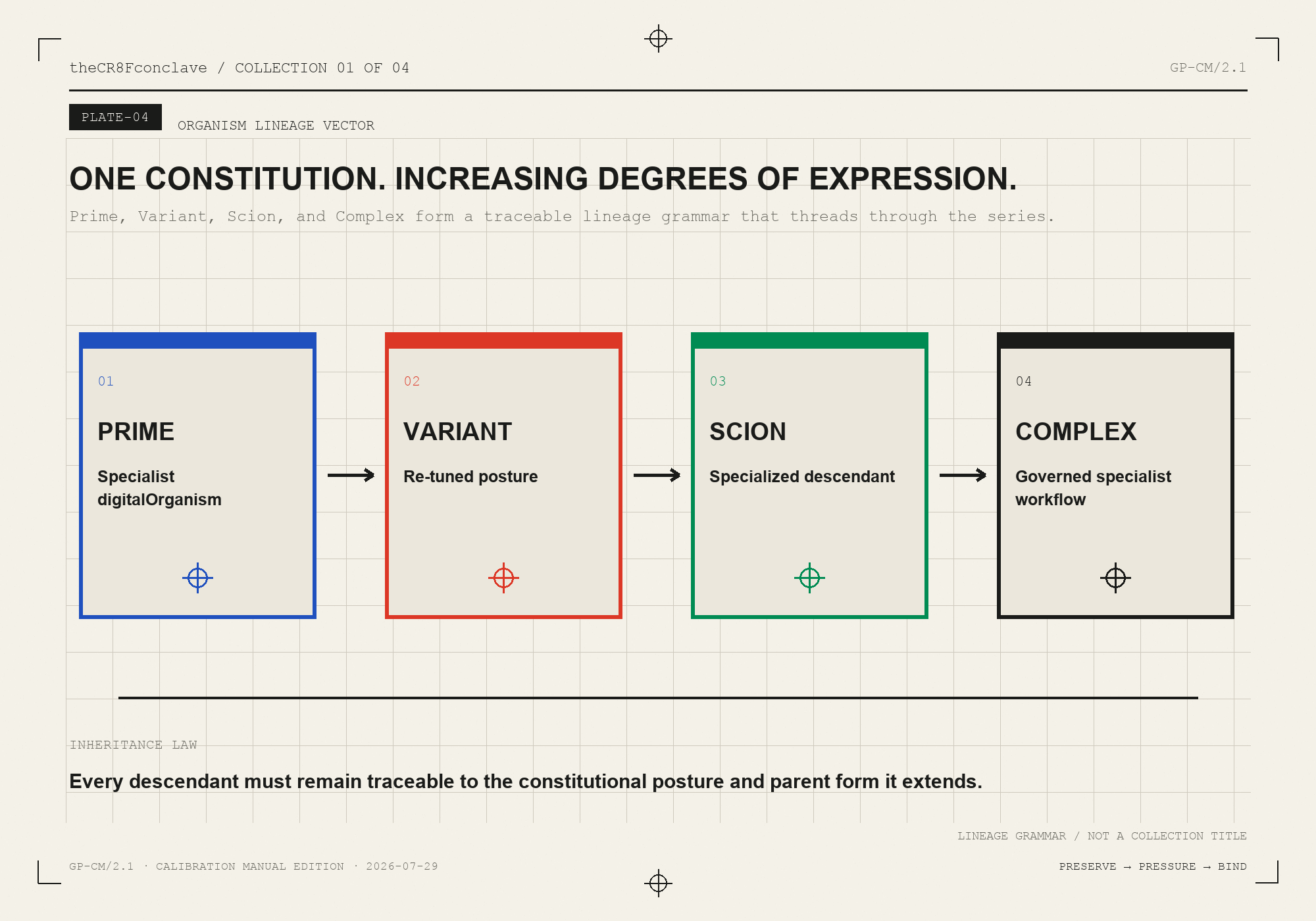
Organism lineage plate showing Prime, Variant, Scion, and Complex as traceable degrees of expression.
Lineage grammar / Prime → Variant → Scion → Complex Plate 03 / 04
Open the LUX guide
LUX preserve standard sheet for holding the mission datum.
Questions that help you name what must remain true.
Open the CHAOS guide
CHAOS pressure standard sheet for exposing weak assumptions.
Prompts for finding contradictions, weak assumptions, and failure points.
Open the SYNTH guide
SYNTH bind standard sheet for turning surviving signal into one shared record.
A practical check for naming the result, attaching its sources, and deciding what happens next.

Your download / Version 2.1

What you get.

The download includes the complete manual, the three individual guides, the reference artwork, and editable Markdown copies of the written material. Read the PDF straight through; use the source files when you want to search or adapt it.

GP / 01

Compiled Field Manual

One designed PDF with the method, examples, glossary, version notes, and license.

1
GP / 02

Individual operation guides

Three separate PDFs, one for each step, when you only need part of the method.

3
GP / 03

Reference plate PDFs

Four visual maps covering the method, its balance, the profile lineage, and the four-Collection plan.

4
GP / 04

High-resolution visual plates

Nine PNG files, including the three operation sheets, control maps, lineage, series plan, blueprint, and cover.

9
GP / 05

Editable source files

Eleven searchable Markdown files with the start-here guide, examples, background, glossary, license, and version notes.

11
01 / Start with the point

In one sentence, what is this work supposed to do?

02 / Name what cannot move

Write down the constraints you are not willing to trade away.

03 / Try to break it

Look for weak evidence, contradictions, and friendly assumptions.

04 / Make the handoff

Record what held up, where it came from, and what happens next.

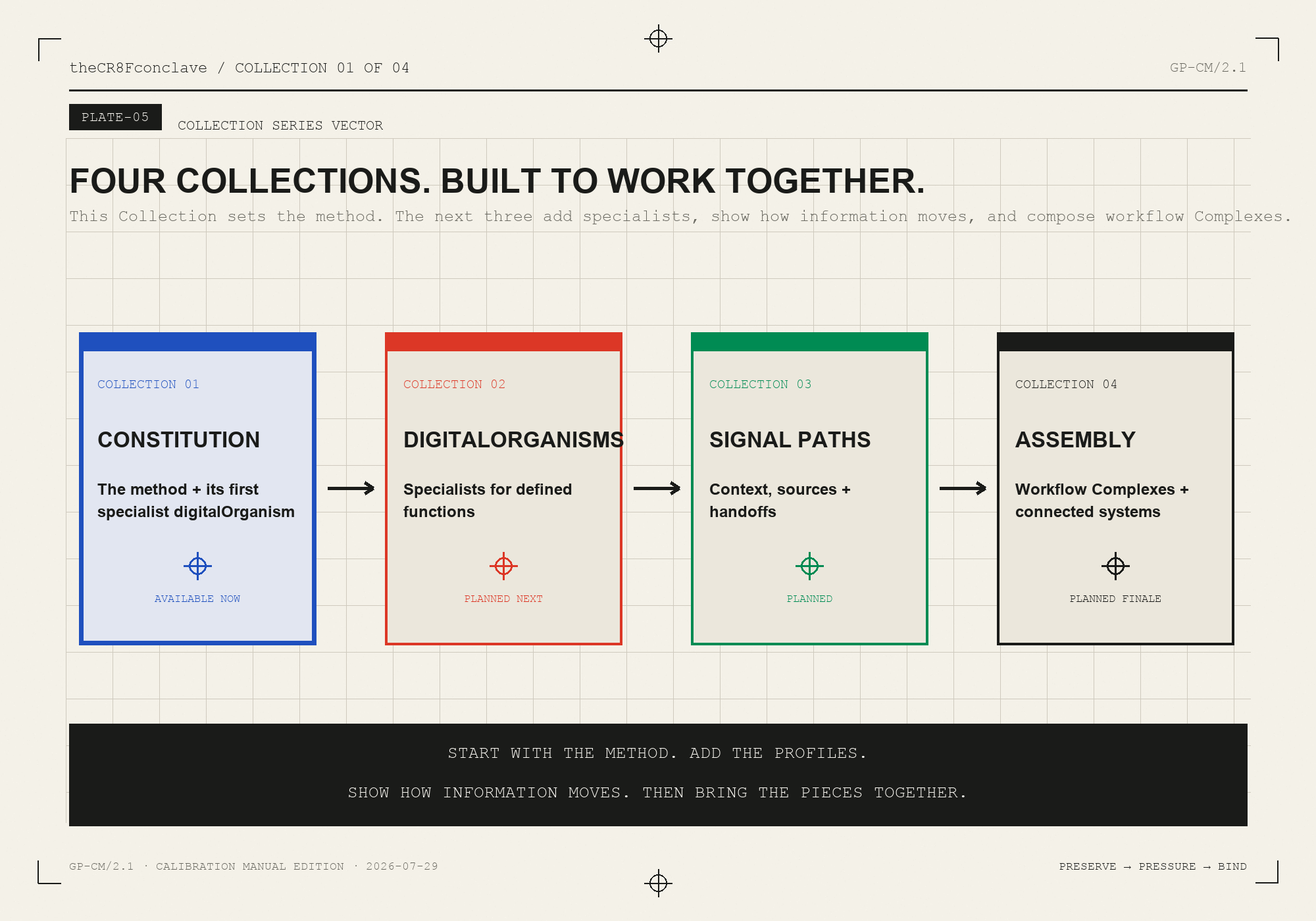
Four-Collection plan / Collection 01 of 04

Where this is going.

Collection 01 starts with the method and the first AI profile built from it. The next three Collections widen the cast, show how information moves between them, and then bring the pieces together.

Four-Collection series vector moving from Constitution to Operators to Signal Paths to Assembly.
Four Collections / one operating system Plate 04 / 04
  1. 01

    Constitution

    Genesis Primitives sets the method. Hazel, Prime is the first AI profile built to use it.

    Current Collection
  2. 02

    AI Profiles

    Hazel is the starting point. Orion, Kai, and Mica follow with different jobs and different limits.

    Planned next
  3. 03

    Signal Paths

    How the profiles receive context, track sources, and hand work to one another.

    Planned
  4. 04

    Assembly

    The method, profiles, and supporting infrastructure working as one system.

    Planned finale

About the lineage names: Prime is the base profile. Variants, Scions, and Complexes describe what is adapted or assembled from there. Those names describe relationships, not the four Collections.

Digital download / ready to use

Use it on something real.

Bring a draft you care about, a decision that feels muddy, or a set of sources that do not quite agree. Work through the three passes and leave with a clear record another person can inspect and pick up.

$49 USD Genesis Primitives — The Triumvirate

Collection 01

The complete opening Collection is available now: the governing method, Hazel, Prime, and the Founder Bundle that brings them together.